
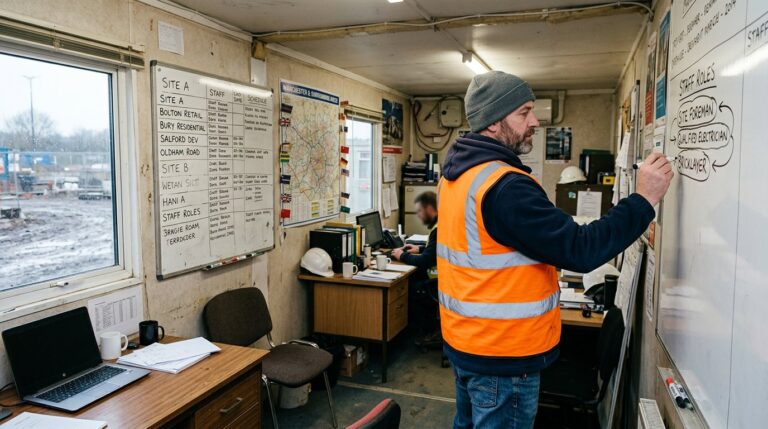
The construction workforce shortage is not going away in 2026. The workforce is getting older, fewer young people are coming in behind them, and CITB’s Construction Skills Network keeps forecasting tens of thousands of extra workers a year that the industry is not finding. For most firms the fastest fix is not the job boards. It is qualifying the experienced people already on your books.
Right, let’s get this straight.
You’ve got work on the books and nobody to put on it.
The advert has been up three weeks. Two people rang. One never turned up.
And the lad you did take on needs a CSCS card before the main contractor will let him through the gate.
That’s the construction workforce shortage as it looks from the cab of your van, and it’s the same story from Leigh to Fulham.
Every year CITB publishes its Construction Skills Network outlook, and every year it says a version of the same thing: the industry needs tens of thousands of extra workers a year to deliver the work that’s planned, and it is nowhere near recruiting them.
Behind that headline sit three problems that haven’t shifted.
So the construction workforce UK firms are fighting over is smaller than the work, and everyone is fishing in the same pond.
Ask any recruiter and you’ll get the same list. Ask us, and it’s the list of trades our phone rings about most.
Notice what those trades have in common. None of them can be learnt off a screen. They need time on the tools, and time on the tools is exactly what a new recruit hasn’t got.
Here’s the bit a lot of firms miss.
Industry Accreditation, what everybody called grandfather rights, closed on 31 December 2024. Before that, an experienced hand could get a skilled CSCS card on the strength of their years. Now a Blue skilled worker card needs a Level 2 NVQ or a completed apprenticeship, and a Gold supervisor card a Level 3 or 4.
So the bloke with twenty years in who turns up for your interview might be brilliant and still not be able to get on site until his paperwork catches up. We wrote about what that change means in our guide to grandfather rights and Industry Accreditation.
The result is that “skilled” and “provably skilled” have come apart, and clients only accept the second one. If you’re being asked for that proof right now, read our post on what to send when a client wants evidence your workforce is competent.
Stop looking at the job boards for a minute and look at your own crew.
Somewhere in your firm is a labourer who has been laying blocks for three years. A joiner on a Blue card who runs the gang whenever the foreman is off. A gaffer with fifteen years in who has never had a certificate to his name.
Those people are your workforce plan. They already know your jobs, your standards and your van keys. They just aren’t qualified on paper.
An NVQ fixes that without taking them off site. Our assessor comes to the job, watches them work, gathers the photos and job records that already exist, and builds the portfolio around the work they are doing anyway. No college, no exams, no days lost.
The rough rule is two to three years in the trade for a Level 2, and real responsibility for other people for a Level 3. If they fit, they qualify. It takes months, not years, and we go through the timeline in how long does an NVQ take.
And before you say you can’t afford to train people while work is tight, check your eligibility for funding. A lot of NVQs are funded for the learner, and if you’re a CITB levy-registered employer there’s a grant on top when they achieve. Our CITB NVQ grants guide covers that side.
You don’t need a consultant for this. You need a spreadsheet and an hour.
Do that and the construction skills shortage stops being something that happens to you. You’ll still feel it. Everybody will. But your firm will have a bench, and the firms with a bench are the ones still winning tenders in a year’s time.
We’re DMR Training. We’ve been qualifying experienced construction workers on site since 2013, and this year’s achievement rate is 98.36 percent, so we know how to get people through. Ring us on 01942 673047 and we’ll do a quick skills scan of your crew, tell you who qualifies for what, and check the funding for each of them. No hard sell, just a straight answer.
Yes. CITB’s Construction Skills Network outlook forecasts tens of thousands of extra workers needed every year, and the industry is not recruiting them. The workforce is ageing, fewer young people are coming in, and a lot of EU labour left after 2019. Every firm we talk to is feeling it in one trade or another.
Bricklayers, groundworkers, site carpenters, dry liners, roofers, cladders, passive fire protection installers and insulation installers of every kind. Supervisors and site managers are the hardest of all to replace. What they share is that none of them can be learnt quickly, which is why growing your own workforce beats waiting for the right advert reply.
You can hire them, but they may not get on site. Industry Accreditation closed on 31 December 2024, so a skilled CSCS card now needs a Level 2 NVQ or an apprenticeship, and a supervisor card a Level 3 or 4. The good news is an experienced worker can be assessed on your site while they work, so the card catches up with the skill.
It turns the experienced people you already employ into provably skilled workers. Our assessor comes to site, observes the work and builds the portfolio from records that already exist, so nobody leaves the job. A Level 2 gets a Blue card, a Level 3 gets a Gold, and your firm gains a bench it can put on any tender.
Often, yes. Many NVQs are funded for the learner depending on where they live and work, and CITB levy-registered employers can usually claim a grant when a worker achieves a qualification. The rules vary by region and by year, so the honest answer is to check your eligibility for funding with us before you assume you have to pay.
To provide the best experiences, we use basic cookies to improve your browsing experience. Some features might not work perfectly if you opt out.