
The short answer
A fire stopper installs passive fire protection, sealing the gaps and penetrations through fire-rated walls and floors so fire and smoke stay in one compartment long enough for people to get out. The work is inspected, photographed, and signed off. The recognised qualification is the Level 2 NVQ in Passive Fire Protection.
Okay, let’s get into it.
Five years ago, hardly anyone had heard of this job. Fire stopping used to be the last task on many construction sites before the ceilings went up.
Nobody checked it, and nobody could see it.
That’s until the Building Safety Act 2022 arrived. Now fire stopping has to be done properly, by people who can prove they’re competent, with the toughest checks on higher-risk buildings.
So if you’re a firm being asked for fire stopping competence, or an installer wondering if this trade has a future, well we’ve got you mate.
If you’re not already aware, let’s get you in the know.
Buildings are split into fire compartments. Walls and floors are built to hold fire and smoke back for a set time, usually thirty, sixty, or a hundred and twenty minutes, so people can escape and the fire brigade can get in there.
So, every pipe, cable, duct and tray that passes through one of those walls makes a hole.
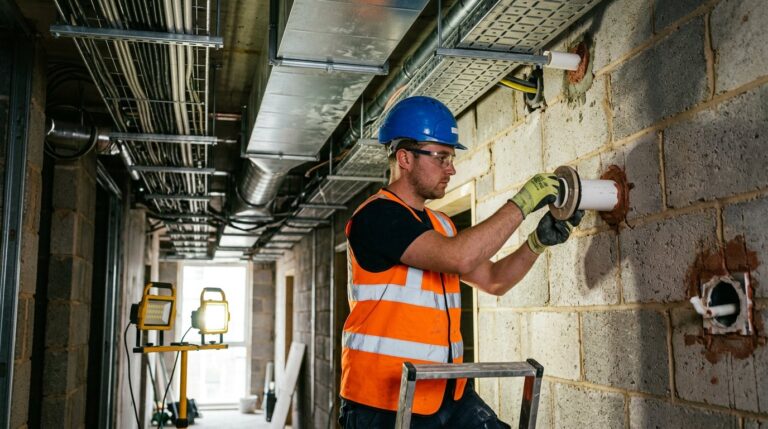
And every hole is a breach. So, what a fire stopper does is close every one of them with a tested system that restores the wall’s fire rating.
That means knowing which product is tested for which situation.
A plastic pipe needs a collar that crushes it shut as it melts, a cable tray needs a batt and sealant system, a linear gap at the head of a wall needs something else.
The other half of the job is the record. Every seal gets labelled, photographed and logged, usually on a digital system with a location plan, so the building owner can show what was done, where, by whom and with what.
On higher-risk buildings, that record forms part of the golden thread of information the Building Safety Act requires.
It’s a hands-on trade with more paperwork than most.
Surveying. Walking the compartment lines on the drawings, finding every penetration and gap, and deciding which tested detail applies.
Installing. Fitting collars, wraps, batts, sealants, pillows and boards to manufacturer detail, in ceiling voids, risers, plant rooms and behind the plasterboard.
Labelling and recording. Tagging every seal and logging it with photos before it’s covered up.
Remedial work. A lot of fire stopping today is going back into existing buildings, opening up ceilings and putting right what was never done properly the first time.
Working with other trades. Electricians and plumbers are still coming through, so the fire stopper is often the last person to look at a wall and the first to be blamed if something’s wrong.
Right, you run a firm, so this section is for you.
The Building Safety Act 2022 puts a duty on contractors to make sure the people doing the work are competent, and to be able to prove it.
What they want is not a promise. It’s a certificate for each installer, a card behind it, and a record of the work.
For a firm, the gap usually looks like this. You’ve got good installers who’ve been doing it for years, mostly trained by the product manufacturers, with nothing behind their name. That’s fixable, and it’s quicker than you think.
Demand is strong and growing. The Building Safety Act 2022 and tighter checks by main contractors mean more fire stopping work in new and existing buildings than there are qualified people to do it.
It’s a skilled trade with a long runway, and qualified installers with a card are the ones who get the better paid jobs.
Here’s the honest bit. A fire stopper with three years in passive fire protection, or two plus time in a similar trade, already knows the job. What they haven’t got is anything that says so.
That’s what the NVQ in Passive Fire Protection is for. Nobody sits in a classroom and nobody takes a week off. An assessor comes out to site, watches them work, and signs off the jobs they’re already doing.
Pass it and they can go for the blue CSCS Skilled Worker card. The red Experienced Worker card keeps them on site while they get there. Both need a current CITB Health, Safety and Environment test. No test, no card, simple as that.
If you’re a firm that needs its fire stoppers provable before the next audit, or an installer who wants the card that matches the work you’ve been doing for years, ring us on 01942 673047.
We’ll tell you straight whether the NVQ Level 2 Passive Fire Protection fits, how the assessment works around live jobs, and whether funding’s likely.
To provide the best experiences, we use basic cookies to improve your browsing experience. Some features might not work perfectly if you opt out.