
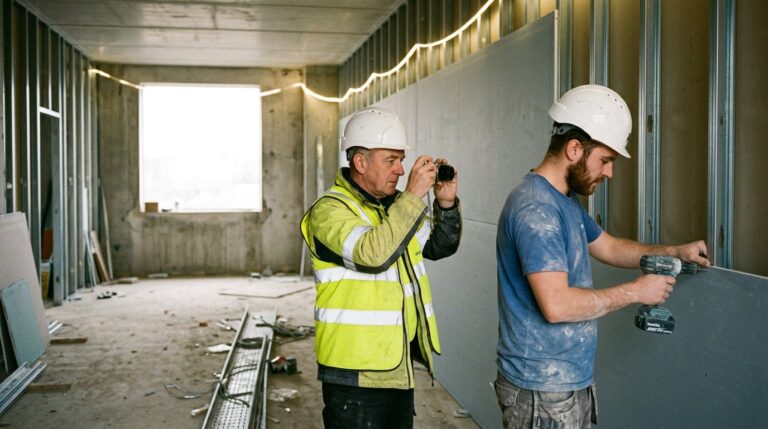
An on-site assessment NVQ means the assessor comes to your site and judges your competence on the work you’ve already been doing. On the day, they observe you, photograph the work, ask questions and collect evidence like drawings and witness statements. There’s no exam and no classroom. Across a few visits, the evidence builds until every unit is signed off and the certificate is issued.
Right let’s get this straight.
The phrase ‘on-site assessment’ gets used a lot explained almost never. People picture an inspector with a clipboard marking them down for a wonky joint.
Employers picture a stranger wandering around the site, slowing everyone down.
Neither is what happens. So here’s how the day starts and finishes, from the people who do them every week.
A construction NVQ is a competence qualification. It doesn’t test what you know in a room, it confirms that you can actually do the job.
Realistically, the only way to confirm that if for a qualified assessor to see your doing on the job. So that’s where the assessment happens, at your work
That’s our whole model. Registration, an assigned assessor, and a plan to observe your job and visit while you work. The evidence for each unit of the qualification comes from what they see and what you know.
Since Industry Accreditation closed on 31 December 2024, this is the route by which experienced workers get the qualification behind a CSCS card. Blue is a Level 2 NVQ, Gold is Level 3, Black is Level 6 or 7, and all of them are assessed this way.
Nothing happens on site until your assessor knows what your site looks like.
You’ll get a phone or video call. They’ll ask what you’ve been working on, how long you’ve been in the trade, what the next few weeks of the job looks like and what you’ve done before.
This is where a good assessor earns their keep. A joiner on a housing site is going to hit first fix, second fix, and roof carpentry naturally.
A joiner on a shopfit isn’t. So the assessor plans for the gaps, maybe with photos from a previous job or a statement from a former gaffer.
You’ll also be told what to start gathering now, before anyone visits. Our post on what to do before you start your NVQ lists it.
Your assessor arrives, signs in, does the site induction like anyone else, and finds you.
Then they observe you working for a period, usually a morning or a couple of hours, depending on what’s planned. They’re looking at four things:
They photograph the work, make notes and record which units the observation covers. Then they get out of your way.
An observation on one day can’t cover everything, so the assessor gathers evidence from other places too.
All of it goes into your portfolio, and most of it goes in from your phone. Your assessor gives you the full list at the planning call.
Your assessor reviews everything against the standard, unit by unit. Each one is either competent or not yet competent.
‘Not yet’ means the evidence isn’t complete, not that you’ve done something wrong. They’ll tell you exactly what’s missing and the quickest way to fill it, which might be another observation on the next job, a photo from an old one or a witness statement.
The work is also checked by an internal quality assurer, which is a second qualified person making sure the assessment was fair and consistent. Once every unit is signed off, the claim goes to the awarding organisation named on your certificate, and they issue it.
How many visits it takes depends on your job and how quickly you gather evidence, not on a timetable. Some people are done in a few months, some take longer because their site doesn’t produce the evidence until later. Nobody’s clock runs out.
People search for ‘NVQ assessor qualification’ for two reasons: they want to know who’s judging them, or they fancy doing the job themselves.
On the first, your assessor is two things. They’re occupationally competent, which means they’ve worked the trade they assess, and they hold a recognised assessor qualification, which means they’ve been trained and are checked on how they assess. A bricklayer assesses bricklayers. A site manager assesses site managers.
On the second, DMR assesses construction NVQs. We don’t deliver assessor training. If you’re a tradesperson who’s interested in becoming an assessor, the recognised assessor award is the starting point, and it’s worth having a trade qualification and plenty of time on the tools behind you first.
If you run the firm, here’s how much a visit disrupts the site: almost not at all.
The assessor inducts like any visitor, watches one person for part of a shift and leaves. Nobody’s pulled off the job. The paperwork they need is stuff you already have. The one thing we’d ask is that a supervisor is willing to sign a witness statement, which takes five minutes.
What you get is a workforce you can prove, which is what a client’s competence check, CDM 2015 Regulation 8 and the Building Safety Act are all really asking for. And with several people on the same site, one visit can cover more than one candidate.
If you’ve been doing the job for years and want it on paper without a classroom in sight, ring us on 01942 673047. We’ll tell you which level fits, how the visits would run around your site, and how to check your eligibility for funding. We’ve been delivering the on-site assessment NVQ since 2013 and our assessors are all trade first.
To provide the best experiences, we use basic cookies to improve your browsing experience. Some features might not work perfectly if you opt out.