
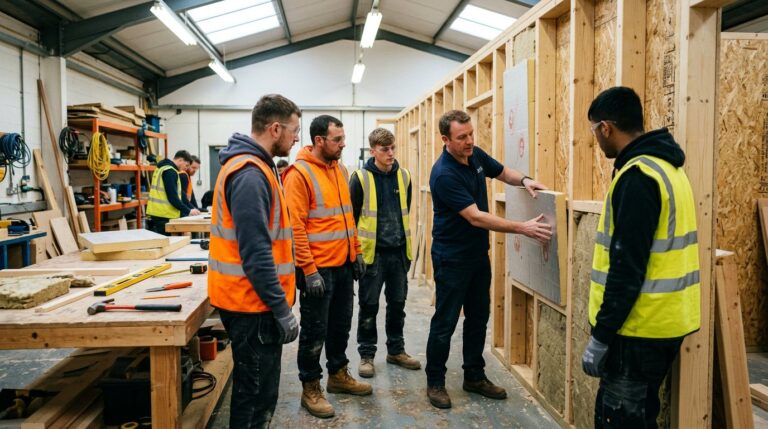
A Skills Bootcamp is a short, government funded training programme of up to 16 weeks for adults in England, free to the learner. Through a skills bootcamp construction employers can train up a crew they already employ in a new skill such as insulation, or recruit through the guaranteed interview every bootcamp has to offer. Ask us which bootcamps we’re running this year and whether your firm qualifies.
Loads of employers have heard the words “Skills Bootcamp” and filed them under “something to do with computers”.
Fair enough. A lot of the early ones were digital.
But the construction ones exist, we’ve run them, and for a firm that needs a crew skilled up quickly they are one of the most useful tools going.
So here’s the employer’s version, updated for how the scheme works now.
Skills Bootcamps are funded by the Department for Education. They’re flexible programmes of up to 16 weeks, aimed at adults aged 19 and over who live in England, and they’re built around a specific skill an employer actually needs.
The learner pays nothing. Every bootcamp has to end in something real: for someone out of work, a guaranteed job interview; for someone already employed, a new role, new responsibilities or a pay conversation with their employer.
That last bit is what makes them different from a short course. A bootcamp is meant to change what someone does on Monday morning, not just add a certificate to the drawer.
Three things, in our experience.
Retrain an existing crew. You’ve got general builders or roofers and the work coming in is insulation. A bootcamp gets them the underpinning knowledge and the practical skills for a new measure in a block, then they go on site and earn while we assess them for the NVQ that PAS 2030 and TrustMark expect.
Recruit with less risk. The guaranteed interview works both ways. You see people who’ve just done 16 weeks on the exact skill you need, and they come to you with the basics done. If you’re struggling to find and recruit skilled workers, it’s a pipeline the job boards can’t give you.
Move into retrofit at all. Warm Homes and other insulation funding has switched on a market a lot of firms want a piece of. A green skills bootcamp is the fastest way to get a crew ready for it. Our post on why retrofit is important explains the size of what’s coming.
The Department for Education sets the rules, and they get refreshed with each funding round, so treat this as the shape rather than the small print.
For employers putting their own staff through, there’s normally a contribution from the business, with smaller firms asked for less than large ones. The exact rule changes, so check the current position with us rather than a two-year-old forum post. For learners who are unemployed or self-employed, the bootcamp is fully funded.
Up to 16 weeks is the ceiling, not a promise. Construction bootcamps are usually shorter and denser, with a mix of training room days and hands-on practice, arranged so people can keep working around it.
A typical structure is a block of underpinning knowledge, then practical sessions on the measure, then a route straight onto site. The bootcamp is where the skill gets learnt. The NVQ is where it gets proved, on the job, with our assessor observing the real work.
That’s the combination that gets a firm a competent, qualified and provable crew in the shortest time we know of.
People treat them as rivals. They’re not. They do different jobs.
| Skills Bootcamp | Construction NVQ | |
|---|---|---|
| What it is | Short training in a new skill | Assessment of skills you already use |
| Who it suits | Workers moving into a new measure or trade area | Experienced workers with two to three years on the tools |
| Where it happens | Training room plus practical sessions | On your site, while working |
| Length | Up to 16 weeks | Months, at the learner’s pace |
| What you get | A certificate and an interview or new role | A nationally recognised qualification and the CSCS card that goes with it |
For an experienced insulation installer who has never held the paper, skip the bootcamp and go straight for the NVQ, for example the Level 2 NVQ in Cavity Wall Insulation. For a roofer who has never fitted insulation, the bootcamp comes first and the NVQ follows once they’ve got time on the tools.
This changes with each funding round, which is why we won’t print a list that goes stale. We’ve delivered a green skills bootcamp in energy efficiency, and retrofit and insulation remain the areas where employer demand is strongest.
If you’ve got a crew in mind and a skill you need them to have, tell us. Where there’s enough employer demand we can shape a bootcamp around it, and we’ve answered the common questions in our Skills Bootcamps FAQs.
We’re DMR Training. We’ve been qualifying construction workers on site since 2013, and bootcamps are the bit we add when a firm needs a new skill fast rather than proof of an old one. Ring us on 01942 673047, tell us the crew and the work, and we’ll tell you straight whether a bootcamp, an NVQ or both is the right call, and what funding applies.
A flexible training programme of up to 16 weeks, funded by the Department for Education, that teaches adults a specific construction skill an employer needs, such as an insulation measure. It’s free to the learner and has to end in a guaranteed job interview or, for someone already employed, a new role or responsibilities.
Adults aged 19 or over who live in England, whether employed, self-employed or unemployed and looking for work. The Department for Education refreshes the rules with each funding round, and employers putting their own staff through are usually asked for a contribution, so check the current position with us before you plan around it.
Yes, and that’s the most common way construction firms use them. You put a crew through the bootcamp to learn a new measure, then they go on site and we assess them for the NVQ that proves it. Smaller firms are generally asked for a smaller contribution than large ones.
No. A bootcamp teaches a new skill in a training room and practical sessions. An NVQ assesses skills you already use, on site, while you work. An experienced installer should go straight for the NVQ. Someone moving into a new measure does the bootcamp first and the NVQ once they have time on the tools.
Up to 16 weeks is the maximum. Construction bootcamps are often shorter and more intensive, mixing training room days with hands-on practice so learners can keep working. The structure is usually underpinning knowledge first, then practical sessions on the measure, then straight onto site.
It changes with each funding round, so we don’t publish a list that goes out of date. We’ve delivered a green skills bootcamp in energy efficiency, and retrofit and insulation are where employer demand is strongest. If you have a crew and a skill in mind, ring us and we’ll tell you what’s current.
To provide the best experiences, we use basic cookies to improve your browsing experience. Some features might not work perfectly if you opt out.